

July 14, 2015 4:52 pm
Eletrobrás ruling exposes impact of Brazil’s heavy hand – Financial Times
Joe Leahy in São Paulo
When the Brazilian government was accused last year of violating minority shareholder rights at Eletrobrás, the listed state-controlled electricity operator, it offered an olive branch to the country’s securities regulator.
If the CVM, Brazil’s market watchdog, would drop the case, which alleged that government intervention to force down tariffs cost Eletrobrás an estimated R$8.7bn in lost sales, the government would stage a capital markets seminar on behalf of the regulator free of charge. As a bonus, it would throw in then finance minister, Guido Mantega, as keynote speaker.
The CVM turned down the offer and nearly 12 months later found the government guilty of poor corporate governance in its management of Eletrobrás.
Analysts say that the landmark case may trigger significant changes for the management of other important listed state-controlled groups, such as oil company Petrobras.
“This [the Eletrobrás decision] creates a precedent when we look at Brazilian state as a controlling shareholder of Petrobras, for instance, and many, many other public companies,” says Luis Andre Azevedo, a lawyer with Carvalhosa and Eizirik in São Paulo.
Several cases are already under way at the CVM over a government practice of forcing the oil company to provide a fuel subsidy at the petrol pump at the expense of minority shareholders. The fuel subsidy cost an estimated R$60bn ($19bn) during President Dilma Rousseff’s first term, analysts estimate.
“We have here in Brazil a very intense debate on how to curb the power of the government in state-controlled groups,” says Sergio Lazzarini, professor at a São Paulo business university, Insper.
The Brazilian state is one of the most important shareholders in Latin America’s biggest capital market, directly controlling not only Eletrobrás and Petrobras but also major bank Banco do Brasil and numerous other companies.
The federal government also influences corporate Brazil through state pension funds and its development bank, BNDES, the country’s main long-term lender that also acts as a shareholder in many companies.
Mr Lazzarini estimates the state has equity interests in companies representing about 35 per cent of Brazil’s stock market capitalisation. Companies with borrowings from the BNDES represent about 70 per cent of capitalisation.
Investors in these companies have traditionally tolerated some state interference. However, many argue interventionism has grown more intense over the past eight years under the left-leaning Workers’ Party former president Luiz Inácio Lula da Silva and particularly his protégé, Ms Rousseff.
“When it came to her time, it [intervention] became more visible,” says Paulo Rezende of Valora Gestao de Investimentos, a fund that invests in the oil and infrastructure sectors.
The crunch came in September 2012 when the government intervened in the electricity sector. It suddenly imposed an ultimatum on electricity companies with some energy concessions expiring in 2017 to either sharply reduce their tariffs or risk not having the concessions extended. The measure was part of a government policy of trying to suppress the prices of fuel and energy to control rising inflation.
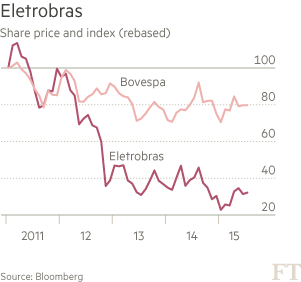
The shares of Brazil’s electricity companies plummeted on the news. Eletrobrás never recovered. The company’s share price remains only about a third of what it was three years ago compared with the benchmark stock index, the Ibovespa, which has fallen only slightly during the same period.
Rating agencies downgraded Eletrobrás’s credit rating after the changes, citing a dramatic fall in earnings before interest, taxation, depreciation and amortisation from the measure. “Ebitda dropped from a positive R$3bn in 2011 to negative R$4bn in 2012,” says Adriane Siva, associate director of Fitch Ratings.
Norwegian fund Skagen, which had a large shareholding in Eletrobrás, filed a complaint against the federal government with the CVM, arguing that the state should have abstained from a shareholder meeting at which there was a vote on whether to accept the government proposal to renew the concessions at lower tariffs.
Minority shareholders had voted to reject the proposal but were overruled by the state as controlling shareholder. Had Eletrobrás shareholders agreed to reject the proposal, the company could have fought the measure in the courts.
In its ruling, the CVM found in favour of Skagen, citing figures showing how the lower tariffs cost Eletrobrás R$8.7bn in lost sales. The state had a conflict of interest as the policymaker and controlling shareholder.
“The important aspect of the decision is that there was a recognition by the CVM that the government is subject to the same rules as any controlling shareholder and shouldn’t have voted in that case,” says Marcelo Barbosa of law firm Vieira Rezende, which represented Skagen.
The ministry of energy, representing the federal government that controls Eletrobrás with a 51 per cent stake, did not respond to repeated requests to comment on the case. Eletrobrás also declined to comment.
The CVM fined the government R$500,000 — light compared with the losses claimed by investors. But lawyers say the decision will now serve as a precedent for similar cases and could also provide the basis for investors in Eletrobrás to sue the government for damages.
Skagen declined to comment on whether it would pursue further action, saying only: “We are now awaiting recommendation from our counsel.”


